
|
||||
|
"Don't hold the bowl." Most wine lovers have heard the rule without quite knowing why. The reason is simple physics: a hand wrapped around the bowl is noticeably warmer than the wine, and that heat moves into the glass faster than people expect. This is the narrow, practical question behind this guide — does hand warmth actually change how a red wine tastes, how much it matters in service, and what it means when you specify stemmed versus stemless glassware for a hotel, restaurant or retail range. |
||||
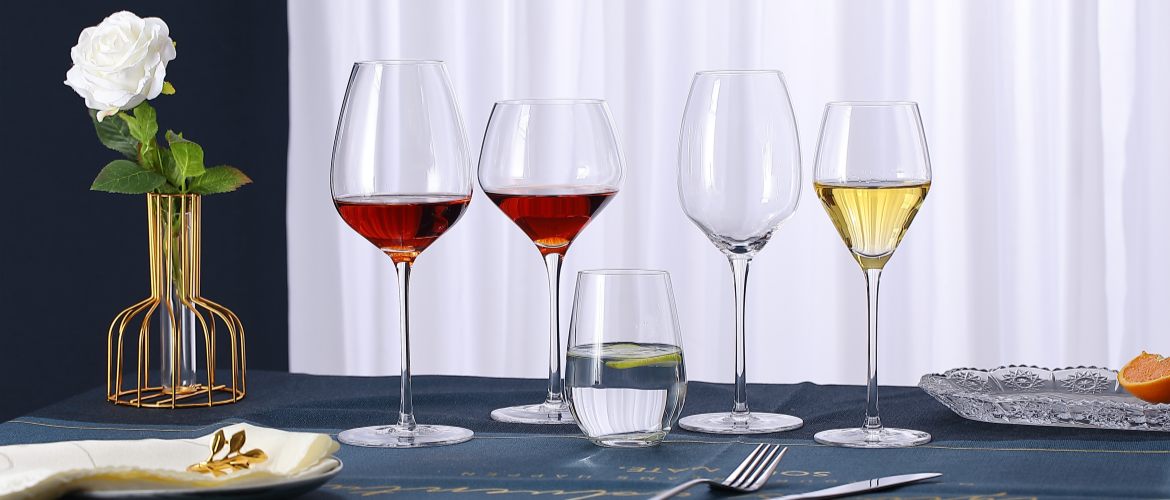
Long stems keep hand heat away from the bowl and the wine inside |
||||
The narrow window red wine is served inRed wine only shows its best within a fairly tight band — light-bodied reds such as Pinot Noir or Gamay around 12–14°C, medium-bodied reds such as Merlot or Sangiovese around 14–16°C, and full-bodied reds such as Cabernet Sauvignon or Syrah around 16–18°C. A move of just a few degrees is enough to change the balance. We cover the full red, white and sparkling chart separately in our guide to how wine temperature affects flavour. That narrow window is exactly why hand heat is worth taking seriously. A properly served red often starts only a few degrees below the point where it begins to taste warm and alcoholic, so it does not have far to drift. |
||||
Does your hand really warm the wine? Yes, and quicklySkin temperature at the palm is far higher than a properly served red — the body runs around 36°C while the wine sits closer to 15°C. When fingers wrap around the bowl, that difference drives heat straight through the wall into the wine. In everyday service a few minutes of holding the bowl can raise a pour by several degrees, enough to push a light or medium red past its ideal range. Glass thickness changes the speed, not the direction:
|
||||
What changes when a red gets too warmAs the wine creeps above its range, the balance shifts in predictable ways:
The cold side has its own fault — an over-chilled red smells closed and the tannins feel hard and tight — but at a table that is rarely the problem. Hand warmth on the bowl is the more common drift, which is why service training focuses on it. |
||||
Why wine glasses have stemsThe stem is an engineering decision, not decoration: it puts distance between a 36°C hand and a 15°C wine. It does three other jobs at the same time:
The correct hold follows directly — pinch the stem between thumb and forefinger, or hold the glass by the base, and keep the palm off the bowl. The two main red-bowl proportions are themselves tuned to how a wine develops in the glass; our notes on Bordeaux versus Burgundy glasses explain the difference. |
||||
When a little warmth actually helpsHand warmth is not always the enemy. It is useful when a bottle has come out too cold — from an over-chilled cellar, an air-conditioned room, or a delicate red that needs help opening. In those cases gently cupping the bowl for a short time nudges the wine up toward its range and brings the aromatics forward. The distinction is intent. Brief, deliberate warming to reach serving temperature is good service; an unconscious hand clamped around the bowl for the whole meal is what pushes the wine past it. |
||||
Stemmed or stemless: a sourcing decisionFor buyers, the hand-temperature question is really a stem specification. A quick way to frame it: Many ranges carry both, matched in bowl shape so a venue looks consistent across formal and casual service. Our full professional wine glass collection spans stemmed red and white shapes and boxed stemware sets, with etched or printed logos and gift or export packing available through our custom finishing services. Food-contact compliance is confirmed in writing per market, with third-party lead and cadmium release reports arranged on request. |
||||
Frequently Asked Questions
|
||||
|



Xml Privacy Policy Blog Sitemap
Copyright © 2026 XINGHUO Glass All Rights Reserved.  Network Supported

 EN
 AR