Which Stemless Wine Glass Is Best?
May 09, 2025
S
Smith Marketing Department, Jiangsu Xinghuo Technology Co., Ltd. · May 09, 2025
Stemless wine glasses are sold on convenience, and convenience is not the whole story. Whether one is right for your range depends on three things: what gets poured into it, who is washing it, and how far it has to travel. That is the frame this page works in, because “best” without those three answers is a marketing word.
The short answer
For a hotel or a restaurant, the best stemless glass is a 400 to 450 ml lead-free crystal tulip with a base of 8 to 12 mm and a rim no thinner than 1.8 mm. It survives a banquet, it looks like glass rather than plastic, and it will not warm the wine faster than the guest drinks it.
For retail, gift sets and outdoor use, the answer is different. A soda-lime or borosilicate tumbler in the 300 to 400 ml range costs less, packs into half the carton height of a stemmed glass, and takes the knocks of a picnic or a poolside. Both answers are correct; they are answering different questions.
What stemless trades away
The name is literal: the bowl sits directly on the base, with no stem between them. It is not a glass “without a handle” — wine glasses never had handles. That confusion turns up in a lot of catalogue copy, and it usually sits next to the claim that the shape works for brandy, water and cocktails alike, which is only half true.
What changes
What it means when you buy
Height
A stemless glass is roughly half the height, so carton volume and freight per unit fall with it
No stem
The part that snaps in transit and in the dishpit is gone, which is where most breakage in a stemmed range comes from
Hand contact
The bowl is now the handle: 150 ml of wine at 16 °C picks up two to four degrees in ten minutes of holding
Rim thickness
The wall carries the load instead of a stem, so a stemless rim is usually 1.8 to 2.2 mm and reads blunter on the lip
Surface area
Fingerprints and lip marks sit on the bowl you look through, so polishing time in front of house goes up
Storage
Stacks in a cupboard, but it will not hang in a stem rack; plan shelf space, not rack space
One more trade is worth stating plainly: a stemless glass puts the rim closer to the table and cuts the headspace above the wine. For a young red that needs air, this is a real loss. For a spirit, a water or a house pour, it makes no difference at all — which is why the shape works far better for a 250 ml lowball than for a Bordeaux.
Material: what each one is for
Three materials cover almost every stemless glass on the market, and they are not interchangeable. The differences that matter to a buyer are refractive index, impact behaviour and cost per unit — not the adjectives on the packaging.
Material
Where it earns its price
What to watch
Lead-free crystal
Banquet, gift boxes, premium retail: the bowl can be drawn thinner and the light bends more, so it reads as glass rather than as plastic
Cost per unit; a rim under 1.5 mm chips on the first busy night
Soda-lime, low-iron
The volume product: hotels, contract ranges, everyday retail. Takes impact better than either alternative at the same wall thickness
Standard batch gives a green edge on thick walls; specify low-iron if clarity is the selling point
Borosilicate
Hot drinks, office, outdoor: it takes thermal shock that would crack soda-lime, and it is lighter in the hand
It resists heat, not impact: at equal wall thickness it is more brittle than soda-lime, so “drop-resistant” is the wrong claim to print
Two claims are worth deleting from any specification you inherit. “Does not contain heavy metals” and “less likely to breed bacteria” are not properties of a material; they are statements that need a test report behind them. If a buyer asks, the answer is a batch migration report for the decoration and the glass, not an adjective. Our crystal range and the borosilicate cup range are both specified that way, and the reports are issued per batch on request.
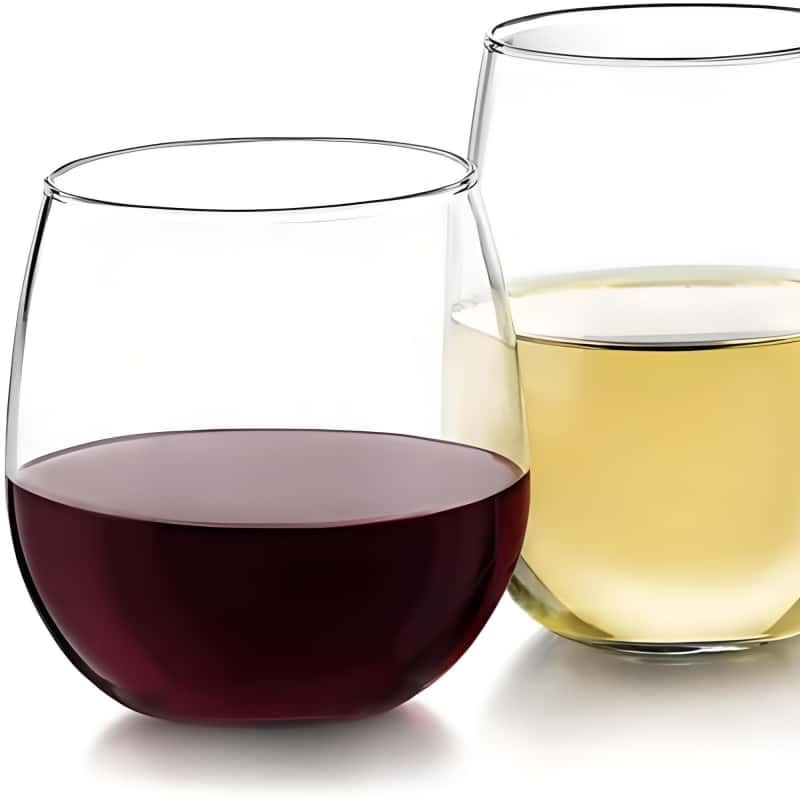
A stemless range in service: thick base for stability, straight wall, no stem to snap.
Capacity by drink
A stemless glass is filled to a third, the same as a stemmed one, so the capacity you choose sets the pour. These are the ranges that work in practice:
Red wine: 400 to 450 ml. A tulip that closes slightly at the rim. Below 400 ml the wine has nowhere to go and the nose turns hot.
White wine: 350 to 400 ml. Straighter sides, narrower bowl. Keep the pour at 100 to 120 ml and it will still hold a chill for the length of a course.
Spirits: 250 to 300 ml. A thick base, 10 mm or more, because a short glass gets pushed around a bar top and a thin base rings and chips.
Water and juice: 300 to 350 ml. Straight wall, no taper. This is the size that stacks well in a fridge door.
Sparkling wine: not recommended. Bubbles need a narrow vessel and a cool wall. Stemless flutes exist, but they are a compromise: the hand warms the bowl, and the bead dies faster than it does in a stemmed flute.
What to check on a sample
Base thickness and flatness. 8 to 12 mm for wine, more for spirits. Stand the glass on a glass shelf and press one side of the rim: a base that rocks was not annealed flat, and it will chip at the edge within a month.
The rim. Run a finger around it, then look at the reflection of a light along the edge. An even line is a fire-polished rim; a wavy line or a bright speck is a chip waiting to happen.
Fifty dishwasher cycles. Not one. Detergent etching shows up as a dull haze after a few hundred washes in soft water with high alkalinity, and it is permanent. If the range is going into hotels, run the sample through the actual machine before you sign off.
Decoration. A decal on the outside of a bowl that gets held and washed is the first thing to fail. If the design needs to last, it belongs on the base or in the base, not on the wall.
The carton, not just the glass. Stemless packs in cells or in moulded pulp, and the savings in freight only appear if the packaging is designed for the shorter height rather than inherited from a stemmed range. Ask for the packed carton dimensions and the drop test level before you compare quotes.
Frequently asked questions
Are stemless glasses better for restaurants?
For banquets, terraces, poolside and any service where a tray travels far, yes: the breakage rate is lower because there is no stem to catch. For a tasting menu where the wine is the point, no: the guest holds the bowl and the wine warms.
Do stemless glasses break more easily?
They break differently. A stemmed glass fails at the stem or where the stem meets the bowl; a stemless glass fails at the rim, usually from a knock against another glass in the sink. Overall loss in a hotel is lower, rim chips are more common.
Is borosilicate a good material for a wine glass?
For hot drinks and outdoor use, yes. For wine, it offers nothing the wine needs: no gain in clarity or aroma, and at equal wall thickness it takes impact less well than soda-lime. Its advantage is thermal, and wine is served cold.
Can stemless glasses go in a commercial dishwasher?
Yes, and they survive it better than stems. The limit is chemistry rather than shape: high-alkalinity detergent and soft water etch the surface over a few hundred cycles. Check the water hardness and the rinse aid dose before blaming the glass.
Related reading
How to choose commercial wine glasses for restaurants and hotels
What wine glass should be used to serve Riesling?
What is the best wine glass for Cabernet Sauvignon?
How to clean crystal glasses without clouding them
Building a stemless range?
Send us the capacities, the material and the market the range is going into. We will come back with the moulds that already exist, the ones that would need tooling, and a sample schedule. Write to export@xinghuoglass.com or see the full glassware range.
Request a Factory Quote




 Network Supported

 EN
 AR