What Is the Best Wine Glass for Cabernet Sauvignon?
May 20, 2025
S
SmithMarketing Department, Jiangsu Xinghuo Technology Co., Ltd. · May 20, 2025
Ask which glass a Cabernet should be poured into and most of the trade answers Bordeaux without hesitating. What rarely gets explained is what that shape is doing, which measurements actually change what the drinker perceives, and whether one bowl can serve a whole wine list without doubling the stock behind the bar. That last question is the one a buyer has to answer.
The short answer
A Bordeaux-shaped stem: a bowl roughly as tall as it is wide, sides that draw in towards a rim narrower than the widest point, a stem long enough to keep a hand off the bowl, and somewhere between 600 and 750 ml of capacity filled to about a third. That is the glass a young Cabernet wants.
The reason is not mysterious. Cabernet Sauvignon is usually 13.5 to 15% alcohol and carries firm tannin. Pour 150 ml of it into a 250 ml glass and the empty space above the wine is small; what reaches the nose is mostly ethanol, and the cassis and cedar sitting underneath it are hard to find. Pour the same 150 ml into a 700 ml bowl and there is room for the wine to move and for aromatic compounds to collect in the air above it at a concentration you can actually smell. The fruit comes forward because the alcohol has been diluted in the headspace, not because the glass does anything to the wine.
If you only want to stock one shape, a 450 to 500 ml universal stem is the compromise most restaurants land on. It handles Cabernet acceptably and covers most of the rest of the list. It will not flatter a 15% Napa Cabernet the way a larger bowl does.
What Cabernet needs from a glass
Headspace. The volume of empty bowl above the wine decides how much ethanol sits at the rim. A 150 ml pour in a 700 ml bowl leaves roughly 550 ml of air; the same pour in a small glass leaves almost none. This single ratio explains more about why big bowls work than any discussion of shape.
A rim narrower than the widest point. The inward taper holds volatile compounds in a smaller opening, so the concentration is higher where your nose arrives. It also sets how much wine leaves the glass each time it is tipped, which changes the size of the sip.
Enough width to swirl. Swirling increases the surface area in contact with air, and it is the fastest way to lift a closed nose. A bowl that is too narrow to swirl without spilling removes that tool from the drinker.
A stem, not a base. Wine served at 16 to 18 °C held in a hand at 33 °C warms quickly. A stem of 80 mm or more keeps fingers where they belong.
A finished rim. The rim is the only part of the glass that touches the drinker. A fire-polished edge at 1.2 to 1.5 mm reads fine and smooth; a cold-cut edge can feel sharper but chips sooner, and a chip is a returned glass.
The tongue-zone story, and what a taper really does
Most explanations of the narrow rim claim it guides the wine to a particular area of the mouth so the drinker tastes fruit first and tannin afterwards. That idea comes from a tongue map printed in a German psychology paper in 1901, which placed sweet at the tip, sour at the sides and bitter at the back. The diagram was a rough summary even then and survived into textbooks mainly by being copied. Tested properly, all five basic tastes can be detected across most of the tongue; the differences in sensitivity are small and vary between people.
So the taper is not a delivery system for taste. It does three things that can be measured. It keeps volatile compounds inside a narrower opening. It controls how much wine leaves the glass per tilt. And it keeps the exposed surface small enough that the wine does not change character between the first course and the last.
What a drinker calls taste is mostly aroma arriving from the back of the mouth, which is why a glass that delivers more aroma changes the experience far more than one that routes the same wine past a different patch of tongue. The same logic disposes of another claim that circulates in supplier copy, that a wide bowl “reduces the acidity”. Acidity is fixed by the wine. Air softens the perception of tannin over hours in a decanter; in a glass, swirling changes the nose within a minute and leaves the tannin where it was.
The numbers worth putting on a spec sheet
Vague words like “large bowl” cost money when a mould has to be quoted. These are the figures that actually change what the drinker gets, and the ones worth writing into a purchase order.
Specification
Working range
What it changes
Bowl capacity
600–750 ml
How much air sits above a 150 ml pour, and therefore how much ethanol reaches the nose
Widest bowl diameter
90–110 mm
Room to swirl without spilling, and the most exposed part of the glass in transit
Rim diameter
55–65 mm
Aroma concentration at the opening, and the size of each sip
Stem height
80–100 mm
Whether a hand warms the bowl, and whether the glass stands up in a rack
Rim thickness
1.2–1.5 mm
How the first contact reads, and how much chipping the dishpit produces
Total height
210–240 mm
Shelf clearance, dishwasher rack height and the size of the packaging cell
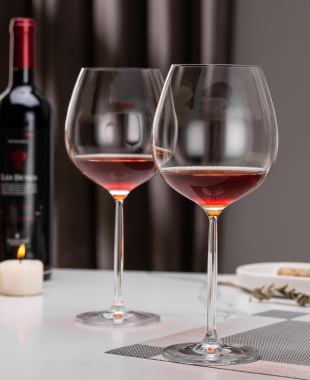
A Bordeaux bowl poured to a third, with the same shape empty alongside. The taper does the work, not the size.
A 660 ml goblet sits at the top of that range. It is generous for a Cabernet and wide enough to double as a water goblet on the same table, which is why it turns up so often in hotel ranges — one mould covering two jobs. Our own 660 ml crystal goblet is built to that logic, and it is worth ordering a sample if you are weighing one shape against two.
Crystal, glass, and what the difference really is
You will read that crystal has light transmittance far beyond ordinary glass. It does not. Clear soda-lime transmits around 91% of visible light and low-iron crystal a point or so more. Nobody can see that difference across a dinner table.
What people are reacting to is something else. Low-iron batch removes the green cast that shows at the edge of a thick soda-lime bowl, so the wine reads as its own colour rather than through a tint. A lead-free crystal mix, usually barium or zinc oxide replacing part of the calcium, lifts the refractive index from about 1.52 to a little above 1.55, and the higher the index the more the material separates light — which is where the sparkle in a cut bowl comes from. And the batch can be drawn thinner without collapsing, which is what allows a 1.2 mm rim in the first place.
That last point is the commercial one. Rim thickness is a mouthfeel decision and a breakage decision at the same time. A 1.2 mm rim feels refined and chips more readily under industrial washing; a 2.0 mm rim is forgiving and reads slightly blunt. For a hotel running two hundred covers a night, the cheaper glass per year is often the heavier one, because replacement rate beats unit price.
Material is not the only variable either. Two stems of identical shape and thickness can survive knocks very differently, because annealing decides how much stress is left locked in the glass after forming. That is a process question rather than a catalogue question, and it belongs in the supplier conversation — see how we handle quality and compliance from forming through packing.
Choosing for a restaurant, or for a range
A restaurant listing three reds can live with one Bordeaux stem. A distributor cannot, because the next buyer's list is never the same as the last one's. Every additional shape multiplies what you hold: shelf space, packaging cells, replacement stock, and the SKUs a warehouse has to count. It also multiplies breakage, because the bowl is the most exposed part of any stem and a wide bowl is the most exposed bowl of all.
Four things worth checking before a range is fixed:
Height against the dishwasher rack, not against the shelf. A 240 mm stem does not fit a 220 mm rack, and hand washing a full stem is a cost that never appears in the quote.
Replacement rate rather than unit price. Ask what proportion of stems the factory expects a hotel to lose in a year, and ask for the answer in writing.
Decoration. An etched band or a fired decal will survive industrial washing; gold and metallic rims will not, and a metallic rim is also a microwave and dishwasher warning on the packaging.
Packing. A stem needs its own cell. Bulk packing a Bordeaux bowl into a divided carton is how a shipment arrives at 96% and the buyer discovers the shortfall at the function.
The purchase order should carry capacity, rim diameter, stem height, total height, rim thickness, material, decoration and packing method — each as a number or a named specification, not an adjective. A crystal wine glass set assembled for retail needs one more line: the box itself, and whether the set is meant to survive being shipped as a gift rather than as freight.
On the production side, the work splits in two: the mould and the finish. Our processing and customisation page covers what can be changed on an existing bowl and what needs a new mould, and the vintage-style stem range shows the shapes already tooled. If you are still deciding how many shapes to carry, start from the glassware range rather than from the wine list.
Frequently asked questions
Does Cabernet need a different glass from Merlot?
Both are Bordeaux varieties and both work in the same bowl. Merlot is softer and slightly lower in tannin, so a marginally narrower bowl flatters it, but the difference is small enough that most lists use one glass for the two.
Can a Burgundy glass be used instead?
It can, and at 14% alcohol the wider bowl pushes the nose towards the alcohol rather than the fruit. You gain aroma volume and lose definition. The Bordeaux and Burgundy comparison sets out where each shape stops working.
Does it have to be crystal?
No. Clarity and rim thinness matter more than the word on the box. A well-made soda-lime stem with a clean 1.5 mm rim reads better in the hand than a thick crystal one, and costs less to replace. Crystal earns its price when the bowl is cut, or when the rim has to be thin without being fragile.
How full should the glass be poured?
A third, roughly 150 ml in a 700 ml bowl. Past that the headspace disappears and the nose turns to alcohol; below a quarter there is too little wine to swirl, and the glass looks mean on the table.
Related reading
Does wine taste better in crystal glasses?
Choosing commercial wine glasses for restaurants and hotels
About Jiangsu Xinghuo Technology and our glassware factory
Sourcing wine glasses for a range?
Send us the capacities, rim diameters and packing method you have in mind. We will come back with the moulds that already exist, the ones that would need tooling, and a sample schedule. Write to export@xinghuoglass.com.
Request a Factory Quote




 Network Supported

 EN
 AR