Crystal Glassware Trends: From Social Media to the Shelf
Sep 15, 2025
S
Smith
Marketing Department, Jiangsu Xinghuo Technology Co., Ltd. · Sep 15, 2025
Social platforms move glassware faster than any catalogue. A glass that turns up in enough short videos can create demand in a market you have never sold to, and it can fade just as quickly. This article looks at what is actually driving that attention, and what it changes for the people buying and producing the glass.
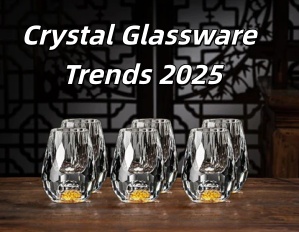
Cut and textured surfaces catch light, which is exactly what makes them work on camera.
What is actually driving the trend
Every few months one glass goes around. A ribbed tumbler, a coloured coupe, a heavy-bottomed highball. The pattern is always the same: a creator films it in good light, the clip travels, retailers start getting asked for something similar, and a factory somewhere has to work out whether the interest is deep enough to justify a mould.
Three things sit behind most of these moments:
Home cafe and home bar culture. People film what they make at home, and the glass is part of the picture rather than a background object. This shifted glassware from a utility purchase to a styling purchase in a large part of the market.
The way short video is shot. Slow pours, natural light, close focus and the sound of liquid hitting glass. All of it favours a product with visible thickness, a cut surface and good clarity, and it penalises anything that reads as thin or cloudy on camera.
Gifting and celebration. Weddings, anniversaries and corporate gifts are the occasions where people are willing to pay for something personalised, and a glass with a name or a date on it fits that need neatly.
None of this is really about the glass being better than the one already on the shelf. It is about the glass being photographable, which is a different specification — and that difference is where most sourcing mistakes start.
Three content patterns that move glassware
Light and texture
Look at almost any glassware clip and you will see the same shot: a drink poured slowly into a cut or ribbed glass with light coming through from behind. That shot only works if there is something in the glass for the light to catch. A plain wall looks flat on camera, while a cut pattern, an embossed surface or a sprayed colour breaks the light up and gives the clip its texture. This is the strongest single driver behind recent demand for decorative crystal, and it explains why so many new ranges are designed for a camera rather than for a table.
Personalisation and gifting
Engraved and printed glass is the second pattern, and it is the one that turns a trend into a repeatable order. Wedding planners, gift retailers and corporate buyers all want a small run with a name, a date or a logo on it. The technical question is which decoration method can handle that run size, because laser engraving, screen printing and decal application carry different setup costs and different minimum quantities, and the difference decides whether a small order is viable at all. Sets work the same way: a high-capacity crystal wine glass set bought as a gift is specified as a set from the first order, because the box and the inner fitment are part of what the customer is paying for.
Seasonal and limited editions
The third pattern is timing. Christmas, Valentine's Day and Mother's Day produce a predictable spike in glassware content, and the brands that ride it work backwards from the delivery date rather than forwards from the design. A limited edition that arrives two weeks after the holiday is not a limited edition; it is next year's stock. Working backwards is also the only way to book mould and decoration capacity before it fills up.
The three patterns overlap constantly — a cut glass, engraved with a name, launched for a holiday is a single product answering all three. What matters for a buyer is knowing which of the three is doing the work, because each one stresses a different part of the supply chain.
What a trend changes at the sourcing stage
A trend looks like a design decision. In practice it is a production decision, and most of the cost sits in the parts a buyer never sees.
Trend signal
What it changes at the factory
Where it goes wrong
Decorative, light-catching surfaces
Cutting, embossing and spray colour have to be scheduled as separate steps
Pattern depth that varies between batches, which shows up immediately on camera
Small personalised runs
Engraving and printing capacity, and the minimum order that makes setup worthwhile
A small custom order queued behind bulk production and missing its date
Seasonal launches
Mould and sample lead times planned backwards from the selling window
Approving the sample too late to produce before the season
Colour-led ranges
Colour matching and batch records held for every reference
A reorder that does not match the first shipment
Gift and set packaging
Inner fitments, boxes and gift cartons specified with the product
Packaging that delays the order after the glass is already finished
A clip that keeps circulating
The specification has to be locked and repeatable for years
A second order that arrives subtly different from the first
Turning a trend into a product that ships
A trend tells you what to make. It does not tell you whether you can make it at the price and the volume your market needs. That part is decided by three things, and they are usually specified separately when they should be settled together.
Material. Lead-free crystal gives the clarity, weight and ring that read as premium on camera. Borosilicate is the choice where heat is involved. Soda-lime covers the volume end of the market. The material decides the price band before anything else does.
Decoration. Cutting, electroplating, spray colour and frosting are the methods behind most of what sells on social platforms. Each has a different minimum order and a different tolerance for commercial washing, so the method should be chosen against where the glass will be used, not only against how it photographs.
Packing. The more elaborate the decoration and the thinner the wall, the more the packing specification has to carry. This is the step that most often decides whether a good product arrives in sellable condition.
A useful rule when a trend is moving fast: order a sample of the finished, packed product rather than a sample of the glass. What you need to judge is the whole thing, and the whole thing is what your customer will photograph.
Where a factory fits in
It is worth being clear about what a factory does and does not do here. A factory does not create the trend, and it does not own the audience. Its job is to take a direction that is already moving and turn it into a product that can be repeated, priced and delivered.
That is the position XINGHUO works from. We are not a consumer brand and we do not appear in brand rankings. We manufacture to a customer's specification under their own label, across lead-free crystal, borosilicate and soda-lime glass, with more than 20 years in the category, and the product range is built to be adapted rather than simply selected.
In practice that means working from a reference image or a sketch, choosing a material and a decoration method that fit the target price, and locking a specification that the inspection process can hold to on every reorder. A trend that cannot be repeated is not a business.
Frequently asked questions
Is it worth chasing a trend that is already everywhere online?
It depends on whether the trend is a shape or a behaviour. A specific product that has already peaked online is usually a race to the bottom, because every supplier can copy it. A behaviour, such as people photographing their drinks at home, lasts for years and keeps generating demand for new designs. Buy the behaviour, not the clip.
Can I order a small run with a logo engraved on it?
Yes, but the method matters more than the quantity. Laser engraving handles small runs with almost no tooling, while printing and decals usually need a plate or a screen and therefore a higher minimum. Tell the factory the quantity and the deadline first, and the decoration method can be chosen to fit rather than the other way round.
How long does it take to go from an idea to a production order?
If the item exists in the factory's range and only the decoration is new, the path is short: confirm the artwork, approve a sample, then produce. If a new mould is required, add the time to build and trial it, which is the step that most often surprises buyers. Either way, the deadline should be stated at the start so the schedule can be planned backwards from it.
How do I avoid running out of stock when something goes viral?
You cannot forecast a viral moment, but you can remove the two things that make it painful: an unrecorded specification and a single supply source. Keep a written specification and a retained sample for every active line so a reorder is exact, and understand your factory's realistic capacity before you promise a delivery date to a retailer.
Have a design you want produced?
Send us the reference, the quantity and the date you need it, and our export team will come back on material, decoration method, tooling and lead time. Email export@xinghuoglass.com or request a quote.
Request a Factory Quote
Related reading
Top Glassware Trends for 2026: Colours, Textures and Designs
Glassware Design Trends 2025: What Leading Brands Are Doing
From Workshop to Table: The Journey of Crystal Glassware



 Network Supported
 EN
 AR