|
||||
|
Drinkware is being bought as much for how it looks and feels as for what it holds. For 2026 the demand coming back to our factory clusters around three things in the glass itself — colour, texture and more expressive shapes — rather than decoration added afterwards. This guide looks at what is actually being specified for retail, café and hospitality ranges, how each effect is made in production, and how to turn a trend into a clear OEM brief without paying for effects you do not need. |
||||
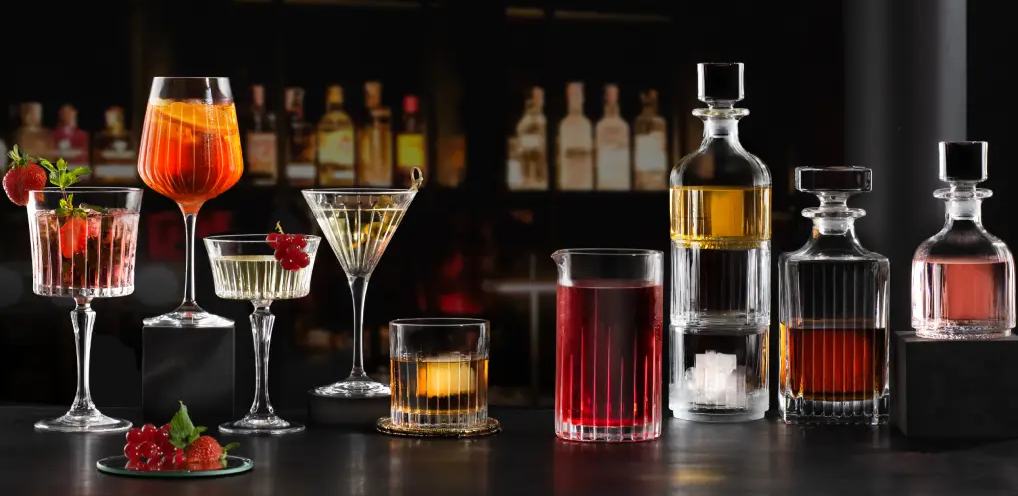
Vertical-rib texture across cocktail, whiskey and decanter pieces in a single coordinated range |
||||
Colour moves into the glass itselfTinted and solid-colour glass has been one of the strongest requests, led by lifestyle retail and hospitality photo-led ranges. The recurring palette is muted rather than neon — ocean blue, amber, smoke grey and emerald green work across both minimal and richer interiors. The production detail matters for buyers, because "coloured glass" is made two very different ways:
Body-tinted colour is the route we recommend for everyday durable ranges; we cover how it is specified and boxed in our notes on solid-colour tumblers for retail gift sets. |
||||
Texture is the premium signalVertical ribbing, fluting, wave patterns and sculpted surfaces have become a signature of current drinkware. Texture does two jobs at once: it gives the hand more grip and it catches light, which makes a glass read as considered and crafted rather than commodity. Again, there are two ways to reach it, with different cost and durability:
A moulded wavy or frosted tumbler is a practical entry point — see our 300 ml wavy frosted hospitality tumbler — and the same texture language carries naturally across water, cocktail and specialty-coffee glasses so a range looks intentional on a shelf or table. |
||||
Sculptural and irregular formsTwisted bodies, asymmetric rims and organic silhouettes are growing for whiskey, cocktail and premium non-alcoholic serves, where the glass functions closer to a piece of tabletop design. Boutique hotels and high-end restaurants use one distinctive shape as a signature piece rather than reworking an entire set. For sourcing, sculptural shapes are a mould investment rather than a finishing cost, so they make most sense as a hero SKU in a larger standard range. Complex curves also change stackability, wall consistency and reject rates, which is worth raising at sampling rather than after tooling. |
||||
Safer, reusable glass stays the baselineBeneath the visual trends, the steady expectation from buyers is safety and reusability rather than novelty. Glass is reusable and recyclable by nature, and a durable soda-lime piece that survives repeated service is genuinely the more sustainable choice versus single-use alternatives — without needing unprovable production claims. What we can stand behind is concrete: lead-free, food-contact-formulated soda-lime glass, durability built for commercial washing, and third-party lead and cadmium release testing arranged for the specific item and market. We do not quote recycled-content percentages or energy-saving figures we cannot document; the honest case for glass is longevity and reusability, and how the materials compare is laid out in our glass material comparison. |
||||
Designed around modern beverage cultureThe shapes follow the drinks people now make at home and order out. The categories showing up most often in 2026 briefs are:
Buyers increasingly spec these as one coordinated family — shared texture or colour across water, coffee and cocktail — rather than unrelated singles. |
||||
Turning the trends into an OEM briefSpecify Pantone references where possible, confirm a finished sample on the actual item (glass tint shifts how a coating reads), and align packaging early — coloured and textured ranges often sell as coordinated gift sets. Our documented quality position is summarised on the quality and compliance page. |
||||
Frequently Asked Questions
|
||||
|



Xml Privacy Policy Blog Sitemap
Copyright © 2026 XINGHUO Glass All Rights Reserved.  Network Supported
 EN
 AR