How a Glass Cup Is Made
Aug 21, 2024
A glass cup looks simple, but it passes through a tightly controlled sequence before it reaches the table: raw materials are weighed and mixed, melted at high temperature, formed by blowing or pressing, annealed to remove internal stress, inspected, decorated and packed. Understanding this process helps importers and brands ask the right questions, because clarity, consistency, heat resistance and durability are decided on the factory floor, not in the catalogue.
This guide walks through how a glass cup is actually made and ends with the manufacturing details worth confirming on a purchase order, from material composition to inspection standard and food-contact reports.
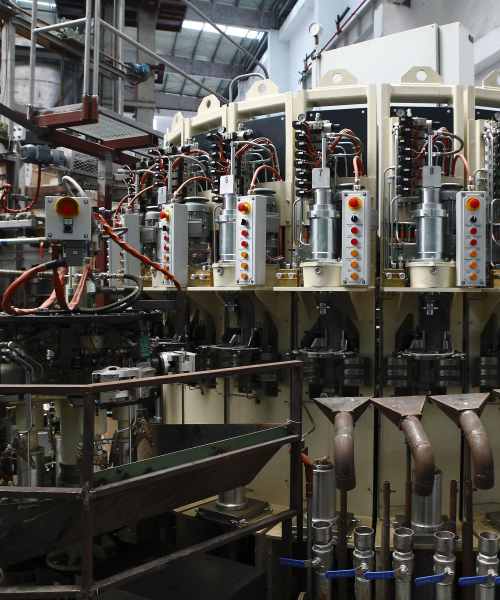
An automatic rotary forming line on the XINGHUO workshop floor, monitored by a production technician
Step 1: Raw materials and the batch
Glass begins with a measured recipe, called the batch. The backbone of most drinkware is silica sand (silicon dioxide). It is combined with soda ash to lower the melting temperature and limestone for chemical durability, plus small amounts of clarifying and colour-adjusting agents. A clarifier such as sulphate helps bubbles rise out of the melt, which is how the glass ends up clear rather than seed-filled.
Accurate proportioning is essential, because the recipe sets the physical and chemical properties of the finished cup. Too much of one component can reduce durability or alter the working temperature. The composition also differs by product family: everyday soda-lime glass uses the classic sand, soda ash and limestone mix, while heat-resistant borosilicate glass introduces boron oxide (roughly 13% B₂O₃ in high-borosilicate ware) for a much lower thermal-expansion coefficient, and lead-free crystal uses alternative additives for extra clarity and a fine finish. You can compare how these behave in our borosilicate versus regular glass guide.
Step 2: Melting and refining
The mixed batch is fed into a furnace and melted at high temperature, typically in the region of 1,400 to 1,550 °C depending on the composition. The molten glass is held long enough to become homogeneous and for bubbles and imperfections to be removed, a stage known as refining. Consistent furnace temperature and residence time matter: they are what keep colour, clarity and viscosity stable across a long production run, which in turn keeps every cup dimensionally consistent.
Step 3: Forming the cup
A gob of molten glass is cut and delivered to a metal mould, where it is shaped by one of three main methods:
Blowing. Air inflates the gob inside a mould. It can be hand-blown by skilled workers for limited or artisanal pieces, or machine-blown on automated lines for high-volume stemware and bowls. Most fine wine glasses are blown because the process allows a thin, even wall.
Pressing. A plunger forces the glass into a mould, which is fast and well suited to thick-walled, straight-sided tumblers, bowls and simple standardised shapes where consistency is the priority.
Tubing and conversion. Glass is drawn into tubes and then cut and reworked into cylindrical and tubular items such as vials and some straight-sided ware. Complex three-dimensional bowls are not produced by drawing; they are blown or pressed and may then receive secondary finishing.
After forming, rims are often fire-polished for a smooth, thin lip, and stems or bases are welded and annealed on stemware. This is also the stage at which colour can be introduced, either body-tinted in the melt or applied as a surface coating.
Hot glass gobs being blown into moulds on an automated production line
Step 4: Annealing
Freshly formed glass is hot and carries internal stress. It passes through an annealing lehr, where it is slowly cooled along a controlled temperature curve rather than chilled quickly. Proper annealing releases that stress and prevents the spontaneous cracking or easy breakage that occurs when a cup leaves the line under tension. This step is easy to overlook but is central to heat-shock resistance and long service life, especially for borosilicate and thin crystal ware.
Step 5: Inspection and testing
Quality control runs through the process rather than happening only at the end. Trained inspectors check for visual defects such as stones, seeds, cracks and uneven rims, and key dimensions are measured to keep the mould within tolerance. In commercial production, batches are assessed under an agreed AQL sampling plan, with critical dimensions and safety-related defects controlled more tightly, rather than relying on a vague promise that every single piece is individually examined.
Samples are also put through thermal-shock and mechanical-stress checks appropriate to the item, to confirm it survives normal service rather than to suggest glass is unbreakable. Before packing, pieces are cleaned to remove dust and handling marks. For food-contact orders we hold ISO 9001, ISO 14001 and ISO 45001 certifications and can arrange third-party lead and cadmium migration test reports for the destination market; we recommend buyers rely on the report, not a logo. More detail is on our quality control and QA process pages.
Step 6: Decoration and finishing
Once a cup passes inspection it can be decorated. Common options include fired-on ceramic decals that survive repeated washing, full-colour digital printing for seasonal designs, etching, frosting and sprayed or electroplated effects. The decoration method affects both the look and the wash life of the glass, so it should be chosen with the sales channel and care instructions in mind, and any logo should be positioned below the lip and away from where the hand grips. You can browse the finished product catalogue and our borosilicate range to see the results.
Recycling and environmental points, stated plainly
Glass is a genuinely recyclable material and can be re-melted as cullet in production, and glass drinkware is reusable for a long service life. At a manufacturer level we manage our environmental systems under ISO 14001. What we do not do is publish recycling percentages, energy-saving figures or furnace claims that we cannot substantiate for a specific line; buyers who need environmental documentation for their market should ask for the specific certificate rather than accept a generic green label. Our compliance position is summarised on the quality and compliance page.
What a buyer should confirm about the process
Detail
What to ask for
Material
Soda-lime, borosilicate or lead-free crystal stated in writing, with composition where relevant
Forming method
Blown, pressed or tubing-based, matched to the wall thickness and shape you need
Annealing
Controlled lehr annealing and a stated thermal-shock rating
Inspection
Agreed AQL level, critical-dimension checks and defect definitions
Food contact
Third-party lead and cadmium migration report matched to your market
Decoration
Process, logo position and confirmed wash durability
For the order-level checks that sit around manufacturing, from packaging to communication and lead times, see our sourcing glassware from China guide.
Frequently asked questions
What is the difference between blown and pressed glass cups?
Blown glass is inflated in a mould and can be made with a thin, even wall, which suits wine glasses and fine bowls; it is made by hand or on automated lines. Pressed glass is forced into a mould by a plunger, which is faster and better for thick-walled, straight-sided tumblers and simple shapes. The method is chosen to suit the design, not the other way around.
Why is annealing important?
Formed glass leaves the mould hot and under internal stress. Slow cooling in an annealing lehr releases that stress; without it, cups can crack spontaneously or fail under modest temperature change. Good annealing is one of the main reasons a glass survives hot and cold drinks without breaking.
At what temperature is glass melted?
Most drinkware batches melt in the region of 1,400 to 1,550 °C, with the exact temperature depending on the composition. Soda-lime and borosilicate recipes have different working ranges, which is one reason consistent furnace control matters for batch-to-batch quality.
How is quality checked on a bulk glass order?
Visual defects and critical dimensions are checked through production, and finished batches are assessed under an agreed AQL sampling plan, with thermal-shock and stress testing on samples and third-party lead and cadmium migration reports available for food-contact orders. Agree the AQL level and defect definitions before production rather than after inspection.
Related reading
XINGHUO glass quality control process
How a B2B glassware supplier runs QA
Borosilicate vs regular glass: a heat-resistance guide
Order glass cups made to your specification
Send us your material, shape, capacity, decoration and target market, and our export team will recommend the right forming process, agree the inspection standard and arrange the food-contact reports you need. Email export@xinghuoglass.com or request a quote.
Request a Factory Quote
S
Smith
Marketing Department, Jiangsu Xinghuo Technology Co., Ltd. · Aug 21, 2024



 Network Supported

 EN
 AR