|
A well-chosen glass jar does more than keep food tidy. It keeps dry goods dry, protects flavour, and lets you see at a glance what you have. Borosilicate glass is a popular choice for this because it resists heat and thermal shock better than ordinary soda-lime glass, and it does not absorb smells or react with acidic, oily or strongly flavoured foods. This guide covers what borosilicate glass jars are actually good for, what they are not, and how the lid and seal matter as much as the jar itself. For buyers sourcing storage ranges, we note what to specify along the way. |
||||
|
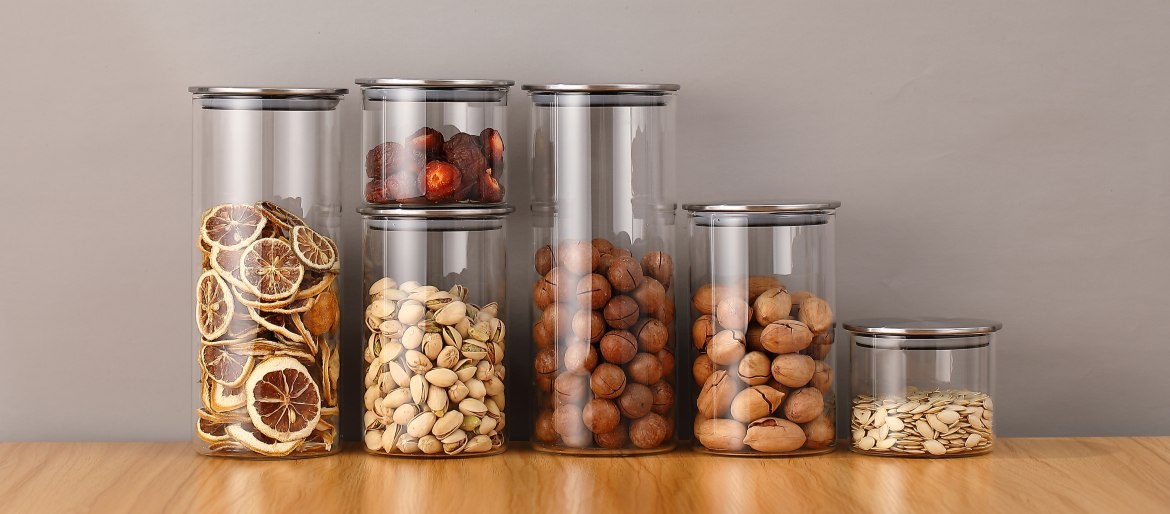
Borosilicate jars in a range of sizes, filled with dried fruit, nuts and seeds: the everyday pantry staples glass stores best |
||||
What makes borosilicate glass differentBorosilicate glass contains roughly 13% boron oxide, which lowers its thermal expansion so it copes with temperature change far better than ordinary glass. In practice, quality borosilicate jars are rated for continuous use from about −20 °C to 150 °C and can survive a thermal shock of around 100 °C, which is why they tolerate going from a cool shelf into warm water without cracking. It is also chemically stable and non-porous, so it will not hold onto the smell of last week's spices or react with tomato, vinegar or oil. That neutrality is the real reason it is favoured for food storage; the transparency is a convenience, not a health claim. For more on how heat resistance is tested, see our guide on how to tell if glass is heat-resistant. |
||||
What you can store in borosilicate glass jars1. Dry goodsThe classic use. Rice, oats, quinoa, beans and lentils, nuts, seeds and dried fruit all keep well in a jar with a good airtight seal, which keeps out moisture, pests and stray odours. This is where glass beats a plastic tub: you can see the level at a glance and the jar will not take on the smell of its contents. 2. Spices, herbs and seasoningsBecause glass neither absorbs nor releases flavour, it is ideal for salt, sugar, pepper, spice blends and dried herbs, as well as homemade chilli oil or infused oils. A small jar with a tight seal keeps ground spices potent far longer than an open packet. 3. LiquidsHoney, jam, maple syrup, soy sauce, vinegar and olive oil are all fine in glass, which is corrosion-resistant and easy to wipe clean. Homemade kombucha and other fermented drinks also work, though these build pressure, so use a jar designed for it and vent as needed. For liquids that spoil in light, such as oils and vinegars, choose an amber or otherwise light-blocking jar. 4. Baking ingredientsFlour, cocoa, baking powder, chocolate chips, sprinkles and food colouring all store neatly in clear jars, and being able to see what is left makes a baking shelf easier to manage. Keep flour and cocoa in a genuinely airtight jar to keep out moisture and pantry moths. 5. Leftovers and meal prepSoups, stews, salads and overnight oats store well in glass, and borosilicate jars can be reheated in a microwave once the lid is removed. Treat any jump from freezer to a hot oven with care: let the jar come back toward room temperature first, and never put a cold jar straight onto a hot surface or under a grill. A wide-mouth jar is easier to fill, eat from and clean. |
||||
What is better stored elsewhereGlass is not the answer to everything. Light-sensitive oils and vinegars need a dark jar or a closed cupboard. Anything that must stay under vacuum, such as opened coffee or vacuum-packed goods, needs a jar with a proper one-way valve rather than a simple lid. And strongly aromatic foods can flavour one another if the seals are poor, so keep garlic, strong spices and fermented items in their own jars. Being honest about these limits is part of choosing the right range. |
||||
The lid and seal matter as much as the jarMost storage failures are seal failures. A silicone gasket in a well-fitted lid is what actually keeps food fresh; the glass body rarely fails first. Common lid options are a stainless-steel or bamboo lid with a silicone ring, a clip-top with a rubber gasket, or a screw lid. Wooden and bamboo lids should be wiped rather than soaked or dishwashed, and silicone rings can be removed and washed separately to keep them odour-free. For buyers, this is the specification that decides complaints: ask for the gasket material, confirm it is food-grade, and check whether the lid is rated for the microwave and dishwasher before you promise it to a customer. We cover the sourcing side in our guide to choosing reliable glass storage jars. |
||||
Using and caring for borosilicate jars
|
||||
Buyer's checklist for a storage jar rangeFor containers designed around heat, see our overview of borosilicate food containers, and browse the borosilicate glass and glass jar and canister ranges, including our airtight storage jar with wooden lid and glass canisters with wooden lids. |
||||
Frequently asked questions
|
||||
|
Related reading Choosing reliable glass storage jars for the Argentine market |
||||
|
||||
|



Xml Privacy Policy Blog Sitemap
Copyright © 2026 XINGHUO Glass All Rights Reserved.  Network Supported

 EN
 AR